

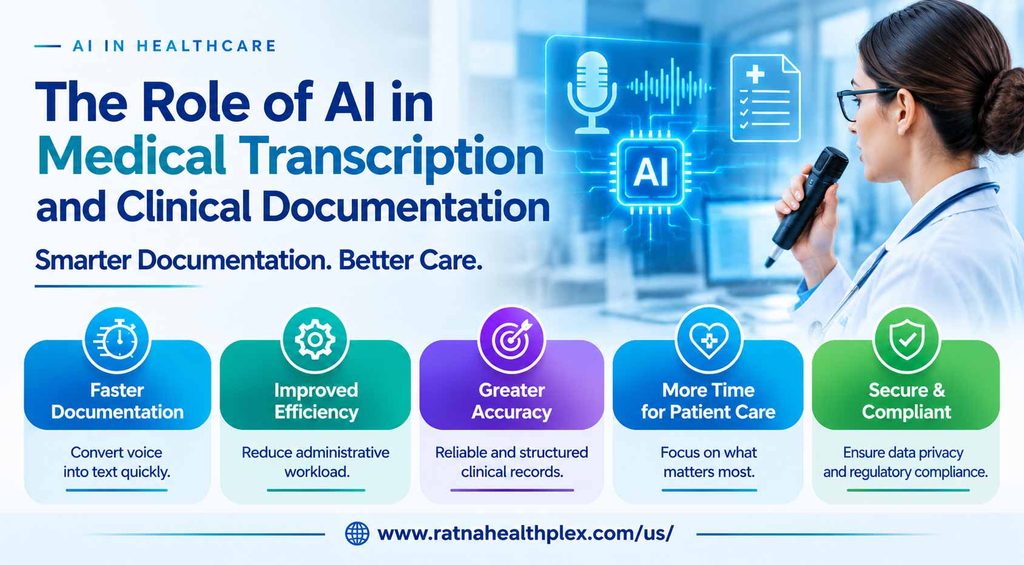
The healthcare industry is undergoing significant digital transformation, with Artificial Intelligence (AI) playing an increasingly important role in improving healthcare operations. From patient management to clinical documentation, AI-powered technologies help healthcare organizations streamline processes, reduce administrative workloads, and improve operational efficiency.
One of the areas experiencing this transformation is medical transcription and clinical documentation. Healthcare professionals spend considerable time documenting patient encounters, updating medical records, and preparing clinical reports. AI-powered medical transcription solutions help simplify these tasks through advanced speech recognition, automation, and Natural Language Processing (NLP).
What Is AI-Powered Medical Transcription?
AI-powered medical transcription uses Artificial Intelligence and speech recognition technology to convert spoken medical information into written clinical documentation.
Traditionally, physicians recorded their observations and dictated medical reports, which were later transcribed manually. This process could be time-consuming and sometimes resulted in documentation delays.
Today, AI-powered systems can process physician dictation, recognize medical terminology, and convert voice recordings into structured text. These solutions can also assist with organizing clinical information and supporting Electronic Health Record (EHR) workflows.
How AI Is Transforming Clinical Documentation
AI is changing how healthcare professionals create, manage, and maintain patient records.
1. Automated Voice-to-Text Transcription
Advanced speech recognition technology converts physician dictation into written medical documentation. This reduces manual typing and supports faster report preparation.
2. Improved Clinical Workflow Efficiency
AI-powered tools help automate repetitive documentation activities, allowing physicians and healthcare staff to spend more time on patient-related responsibilities.
3. Medical Terminology Recognition
Natural Language Processing helps AI systems identify and process medical terminology, clinical phrases, and healthcare-related language, supporting more organized documentation.
4. EHR Integration
AI-powered transcription solutions can support integration with Electronic Health Record systems, helping healthcare organizations maintain accessible and organized patient information.
5. Faster Documentation Turnaround
Automated transcription can help reduce the time required to convert physician dictation into written reports, supporting more efficient documentation workflows.
Key Benefits of AI in Medical Transcription
Implementing AI in medical transcription offers several advantages for healthcare organizations:
- Reduced Administrative Workload: Minimizes repetitive documentation activities.
- Improved Productivity: Helps physicians and healthcare staff manage documentation more efficiently.
- Consistent Documentation: Supports standardized and structured clinical records.
- Better Accessibility: Makes voice-based documentation easier to process and manage.
- Operational Efficiency: Helps healthcare organizations optimize documentation workflows.
However, AI-generated clinical documentation should always be reviewed by qualified professionals to identify errors, verify medical terminology, and ensure that patient records accurately reflect clinical encounters.
Challenges of AI-Based Medical Documentation
Despite its advantages, implementing AI in healthcare documentation comes with certain challenges.
Accuracy and Medical Context: AI systems may occasionally misinterpret complex medical terminology, abbreviations, or physician accents.
Data Privacy and Security: Healthcare organizations must protect sensitive patient information through appropriate security measures and regulatory compliance.
System Integration: Integrating AI transcription tools with existing EHR platforms and healthcare management systems may require technical planning.
Human Oversight: Professional review remains essential to maintain the accuracy and reliability of clinical documentation.
Addressing these challenges is important for successful AI adoption in healthcare environments.
The Future of AI in Medical Transcription and Clinical Documentation
The future of healthcare documentation will increasingly combine AI automation with human expertise. Emerging technologies such as ambient clinical intelligence, advanced voice recognition, and AI-assisted clinical note generation are expected to make documentation workflows more efficient.
These technologies can help capture relevant clinical information during patient encounters, organize medical notes, and reduce the time healthcare professionals spend on administrative activities.
As healthcare organizations continue adopting digital solutions, AI-powered medical transcription will become an important part of modern healthcare operations.
How Ratna HealthPlex Supports Digital Healthcare Workflows
Technology plays an important role in helping healthcare organizations modernize their documentation processes. Ratna HealthPlex focuses on healthcare technology solutions designed to support medical transcription, voice dictation, and efficient healthcare workflows.
By exploring smarter documentation approaches, healthcare organizations can work toward reducing administrative complexity while supporting better information management.
Conclusion
AI is transforming medical transcription and clinical documentation by introducing smarter ways to capture, process, and manage healthcare information. From voice-to-text transcription to improved documentation workflows, AI offers opportunities to enhance productivity and reduce administrative pressure.
Combining AI-powered technology with professional human expertise can help healthcare organizations build more efficient, accurate, and scalable documentation processes.
Ready to explore smarter healthcare documentation solutions?
Visit Ratna HealthPlex to learn more about healthcare technology solutions designed for modern healthcare needs.

VP, Marketing, RatnaGlobalTech.