

Introduction
Artificial Intelligence (AI) is changing how businesses operate, manage workflows, serve customers, and make strategic decisions. In 2027, AI automation is moving beyond simple repetitive tasks to become an important part of everyday business operations.
Organizations are increasingly adopting AI-powered solutions to automate workflows, analyze business data, improve customer experiences, and support faster decision-making.
From automated customer support and intelligent data processing to predictive analytics and AI-powered business applications, automation is helping companies improve operational efficiency while allowing employees to focus on more strategic responsibilities.
But how exactly is AI automation transforming business operations, and what opportunities does it create for modern enterprises?
Let’s explore.
1. What Is AI Automation?
AI automation combines artificial intelligence technologies, machine learning, natural language processing and workflow automation to perform tasks that traditionally require manual effort.
Unlike traditional automation, which follows predefined rules, AI-powered automation can analyze information, recognize patterns, interpret requests and support decisions based on available data.
For example, businesses can use AI automation to:
- Process customer inquiries automatically.
- Generate reports and business insights.
- Automate repetitive administrative tasks.
- Identify unusual patterns in business data.
- Improve sales and customer relationship management.
- Streamline internal workflows across departments.
This enables organizations to move towards smarter, more connected business operations.
2. How AI Automation Is Transforming Business Operations in 2027
A. Intelligent Workflow Automation
One of the biggest applications of AI automation is workflow optimization.
Businesses often manage multiple processes across finance, HR, sales, customer service and operations. Manual coordination can create delays, errors and unnecessary administrative work.
AI-powered workflow automation helps connect these processes, automate repetitive activities and route tasks based on predefined business rules and contextual information.
Business benefits:
- Reduced manual workload.
- Faster task completion.
- Improved process consistency.
- Better coordination between departments.
B. AI-Powered Customer Relationship Management
Customer expectations are increasing, making efficient customer relationship management essential for business growth.
AI-powered CRM solutions help businesses understand customer behavior, identify sales opportunities and improve customer engagement.
With AI integration, organizations can:
- Automate lead scoring and prioritization.
- Analyze customer interactions.
- Generate personalized recommendations.
- Automate follow-up reminders.
- Improve sales forecasting.
Integrating AI with CRM platforms such as Zoho CRM and Salesforce can help businesses build more effective sales and customer management processes.
C. Predictive Analytics and Smarter Decision-Making
Businesses generate large amounts of data through their daily operations. However, collecting data is the only step. Real value comes from understanding it.
AI-powered analytics can identify patterns, forecast trends and provide insights that support better business decisions.
D. AI Agents and Autonomous Business Processes
AI agents are becoming an important part of enterprise automation.
Unlike conventional chatbots that primarily respond to user queries, AI agents can be designed to execute multi-step tasks, interact with business applications, and coordinate workflows within defined permissions.
Examples include:
- Reviewing and categorizing support requests.
- Retrieving information from business systems.
- Preparing reports from multiple data sources.
- Supporting IT incident management.
- Coordinating routine operational workflows.
However, autonomous execution should always include appropriate access controls, monitoring, and human oversight.
E. Automated Software Testing and Quality Assurance
Software quality is essential for organizations developing and maintaining digital products.
AI-powered testing solutions can help software teams generate test cases, identify defects, analyze test results and improve regression testing processes.
AI automation in quality engineering can support:
- Automated test case generation.
- Regression testing.
- API and performance testing.
- Defect identification and analysis.
- Continuous testing within DevOps workflows.
This helps development teams improve testing efficiency and release software with greater confidence.
F. Cloud Operations and IT Automation
Managing cloud infrastructure and IT environments requires continuous monitoring, resource optimization and security management.
AI automation can help IT teams identify unusual system activity, prioritize incidents and support infrastructure management.
Common applications include:
- Automated incident detection.
- Cloud resource optimization.
- Infrastructure monitoring.
- Security event analysis.
- Predictive maintenance.
Combining AI with cloud services can help organizations build more scalable and responsive IT environments.
3. Key Business Benefits of AI Automation
Implementing AI automation can deliver several operational advantages when aligned with the right business objectives.
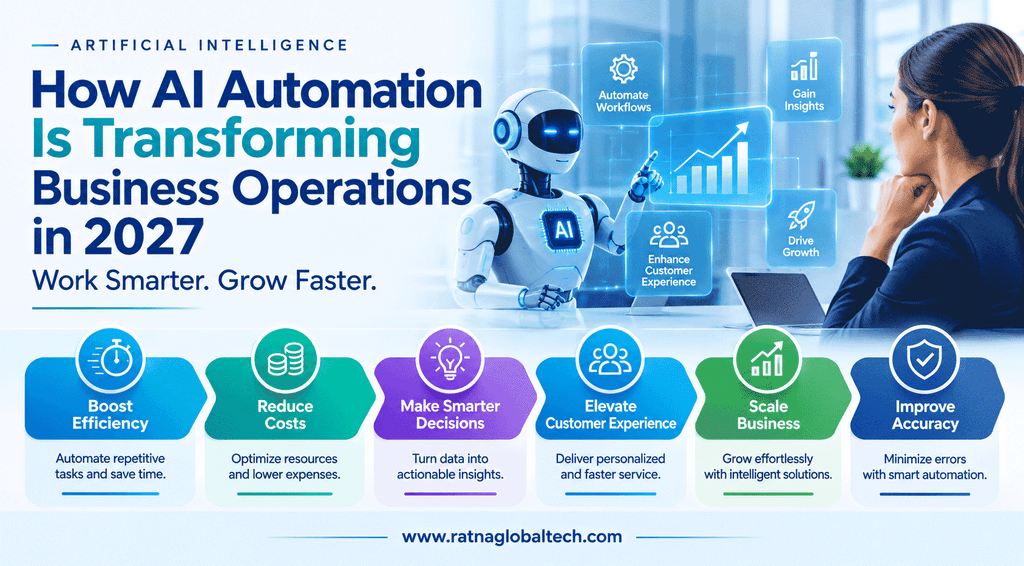
1. Improved Operational Efficiency
Automating repetitive tasks allows employees to spend more time on activities that require creativity, expertise and strategic thinking.
2. Reduced Operational Costs
Optimized workflows can reduce manual effort, unnecessary process steps and avoidable operational expenses.
3. Better Business Decisions
AI-powered analytics provides insights that help management understand performance, identify trends and make informed decisions.
4. Enhanced Customer Experience
Intelligent customer support, personalized interactions and faster response times can improve customer satisfaction.
5. Business Scalability
Automated workflows help businesses manage increasing workloads without relying entirely on additional manual processes.
6. Improved Accuracy and Consistency
Well-designed automation can reduce human errors in repetitive and rule-based processes.
4. Challenges Businesses Should Consider Before Implementing AI Automation
Although AI automation offers significant opportunities, successful implementation requires proper planning.
Some common challenges include:
- Data Quality: Inaccurate or incomplete data can affect AI-generated insights.
- Integration Complexity: Connecting AI solutions with existing enterprise applications can require technical expertise.
- Data Security: Businesses must protect sensitive information and control system access.
- Implementation Costs: AI infrastructure, licensing and ongoing usage costs need careful evaluation.
- Governance and Oversight: Organizations need clear policies defining what AI systems can access and execute.
- Employee Adoption: Teams need appropriate training to work effectively with AI-powered tools.
A structured implementation strategy can help organizations address these challenges and achieve measurable results.
Recommended SEO title
How AI Automation Is Transforming Business Operations in 2027
Meta description
Discover how AI automation is transforming business operations in 2027 through intelligent workflows, AI agents, CRM automation, predictive analytics and cloud solutions.
URL slug
ai-automation-business-operations-2027
Primary keyword
AI Automation Solutions
Secondary keywords
- AI automation in business
- Business process automation
- AI integration services
- AI-powered workflow automation
- Enterprise AI solutions
- AI agents for business
- Business automation solutions

VP, Marketing, RatnaGlobalTech.